
When you see me, weep.
Hunger stones in a scorched Europe

[Deutsch unten]
I am currently travelling on a train across the center of Germany from west to east, past fields and lawns that are no longer green but a dusty, dried-out brown. Our rivers are drying out, the feeds on my machines are full of news like the above, and I thought of the Hungersteine again.
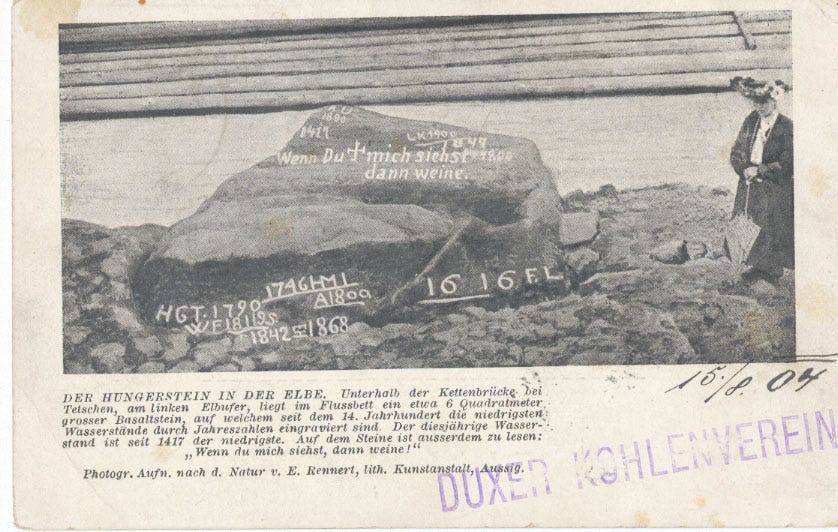
There are many Hungersteine or hunger stones in the rivers of Europe, especially the Danube, the Elbe or the Rhine. Since the 15th century these exposed boulders on the banks or the grounds of the streams mark a great pain, mark drought and famine, and serve as warnings: their carvings tell us to expect hardship when they become visible. The one in the Elbe near Bleckede carries the statement Geht dieser Stein unter, wird das Leben wieder bunter - When this stone goes under, life will become more colourful again. One in the Rhine near Worms-Rheindürkheim just states Hunger. 1857. And one of the most famous, a large boulder in the Elbe in Děčín in the Czech Republic carries marking froms 1616 onwards, and the warning Wenn du mich siehst, dann weine. When you see me, weep.
The Elbe at Děčín is at 80 centimetres currently, and the stone is visible again.
Ich sitze im Zug und fahre quer durch Mitteldeutschland von West nach Ost, vorbei an Feldern und Wiesen, die nicht mehr grün, sondern staubig-braun sind. Der Wasserstand unsere Flüsse nimmt immer mehr ab, meine Nachrichtenfeeds sind voll von Statements wie dem eingangs, und ich musste wieder einmal an die Hungersteine denken.
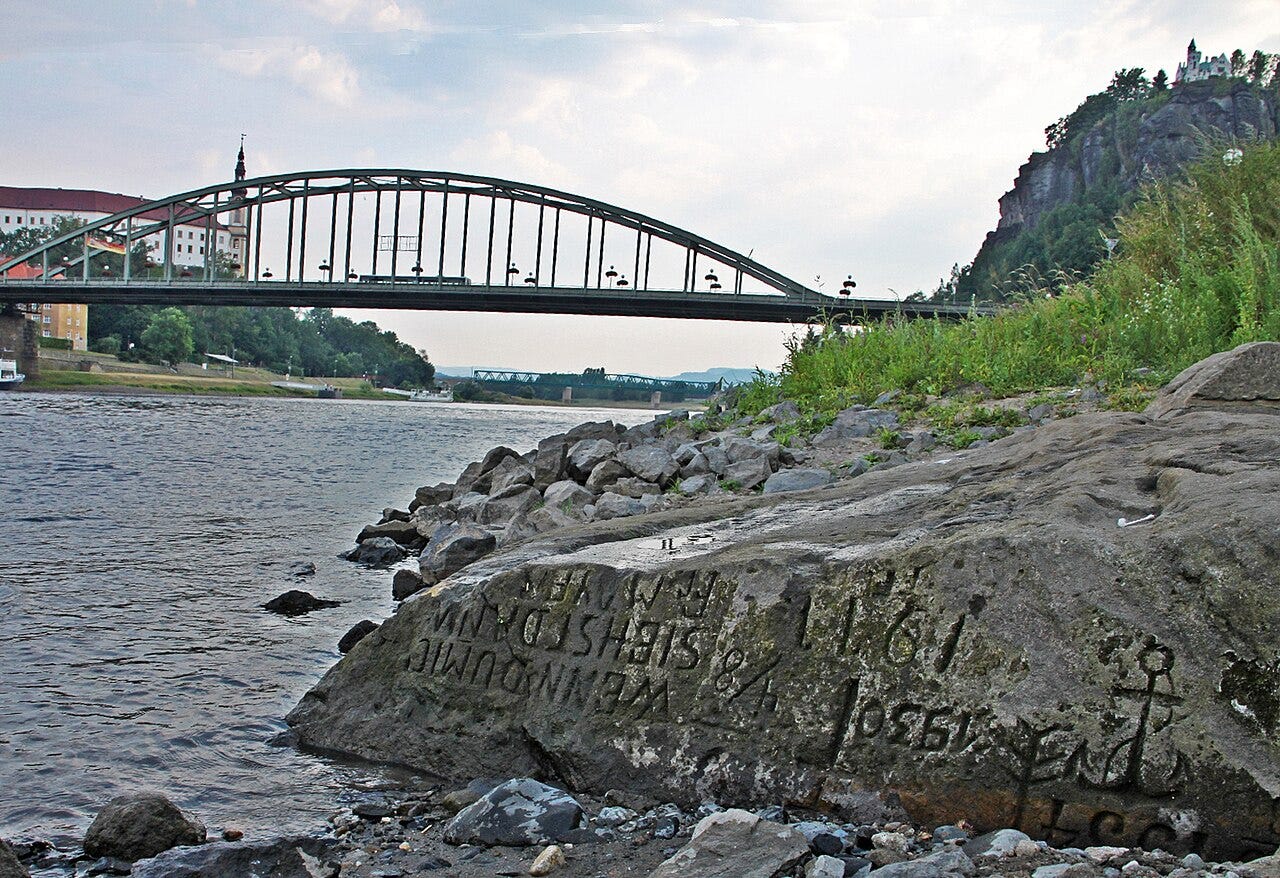
Es gibt viele Hungersteine in den Flüssen Europas, insbesondere in der Donau, der Elbe oder dem Rhein. Seit dem 15. Jahrhundert zeugen diese Felsbrocken an den Ufern oder im Flussbett von großem Leid wenn immer sie frei liegen, zeugen von Dürre und Hungersnot und dienen als Warnungen: Uns selber steht Not bevor, sollten sie sichtbar werden. Der Hungerstein in der Elbe bei Bleckede etwa trägt die Inschrift Geht dieser Stein unter, wird das Leben wieder bunter, und ein Hungerstein im Rhein bei Worms-Rheindürkheim lediglich die Aufschrift Hunger. 1857. Einer der berühmtesten, ein großer Felsbrocken in der Elbe bei Děčín in der Tschechischen Republik, trägt Markierungen ab dem Jahr 1616 sowie die Warnung Wenn du mich siehst, dann weine.
Der Wasserstand der Elbe bei Děčín liegt derzeit bei 80 Zentimetern, und der Stein ist wieder sichtbar.
Beautiful post! I didn’t know about this. Using elements in nature to alert and act as symbols of something bad. If we think deeply, hasn’t nature being sending and showing us those alerts all the time? I think it did. The thing is that, we humans, don’t pay attention to it. Only, sometimes, when it is too late.
Hongersteine, a beautiful word too. You know that my mother used to say that when there is hunger and nothing to eat, people will eat even stones. Being born in the 30’s and having grown up within the turmoil of the 40’s must have been the reason why such a saying was illustrative of what people had to endure. Hunger. In my country, Portugal, not because of climatic reasons but other reasons.
But maybe this saying is associated by whatever reason with your river stones. It is a nice thought, if it was. The bond of people in bad times.